 |
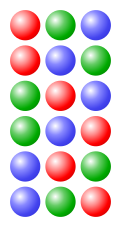
| Permutations of 3 balls (Photo credit: Wikipedia) |
Hello Everyone,
Today I will be telling you how to print all the possible permutations
of a string provided by the user. I will show you the recursive way to
do this.
The programming paradigm that we use in case of Recursion is backtracking.
What do you mean by Permutations ?
A permutation, also called an
“arrangement number” or “order,” is a rearrangement of the elements of
an ordered list S into a one-to-one correspondence with S itself. A
string of length n has n! permutation.
For more info visit here -->
http://mathworld.wolfram.com/Permutation.html
Recursion
This is a bad method for printing permutations since its time complex
i.e. it takes more time to execute than the iterative method this is
because of the extensive use of the
call stack. Now the following image
explains the recursion technique. The image presents the recursion tree
of the method of permutations generation. We take the example string
that we permute as "GOD".
In order to find all possible combinations for a given string, then
start at a position i, then find and place all possible letters in
position i. Every time we put a new letter in position i, we should then
find all the possible combinations at position i+1 – this would be the
recursive call that we make.
Here's the C++ implementation string permutation.
Now the above code will print all the permutations of the string "GOD"
without repetition. But if you want to print them lexicographic manner
i.e where the repetitions of the characters are included then read the
matter below.
Since we are going in
lexicographic order, so we have to do the
following ,its pretty much understandable. (Note : the numbers represent
index and 1 means the starting index , we will not use 0 for the first
index as we do it in programming.)
- Start with index '1' and then recurse over rest of the 'n - 1' numbers.
- Start with '2' and then recurse over rest of the 'n - 2' numbers.
- Start with '3' and then recurse over rest of the 'n - 2' numbers.
:
:
- Start with 'i' and then recurse over rest of the 'n - 2' numbers.
:
:
- Start with 'n' and then recurse over rest of the 'n - 2' numbers.
- Start with a '2' and then recurse over rest of the 'n - 1' numbers.
- Start with '1' and then recurse over rest of the 'n - 2' numbers.
- Start with '3' and then recurse over rest of the 'n - 2' numbers.
:
:
- Start with 'i' and then recurse over rest of the 'n - 2' numbers.
:
:
- Start with 'n' and then recurse over rest of the 'n - 2' numbers.
- :
:
- Start with 'i' and then recurse over rest of the 'n - 1' numbers.
:
:
- Start with 'n' and then recurse over rest of the 'n - 1' numbers.
Important
thing to note is, in every recursion you start with the minimum numbers
left, to be printed, and then keep picking the next minimum, and so on,
till you exhaust all the 'n' numbers.
Here's the C Code for Lexicographical Permutations.
Related articles


![[Image: permute_zps699764b7.png]](https://lh3.googleusercontent.com/blogger_img_proxy/AEn0k_vfQZe4NCaEI0eWdLZIy8b2FJLWJ_gUu-kfFHJnbyx8wgj4oF9q5vtX5xq0E2uYcX7lIuBQfGCx_34eYWx7YsoJyTGetQfUv3RITQEx2Qlr2jUHxO5LuiGV-lgG-dTR5ic2HXzQ3kw3bUrwsDbsc_JqESKB=s0-d)


